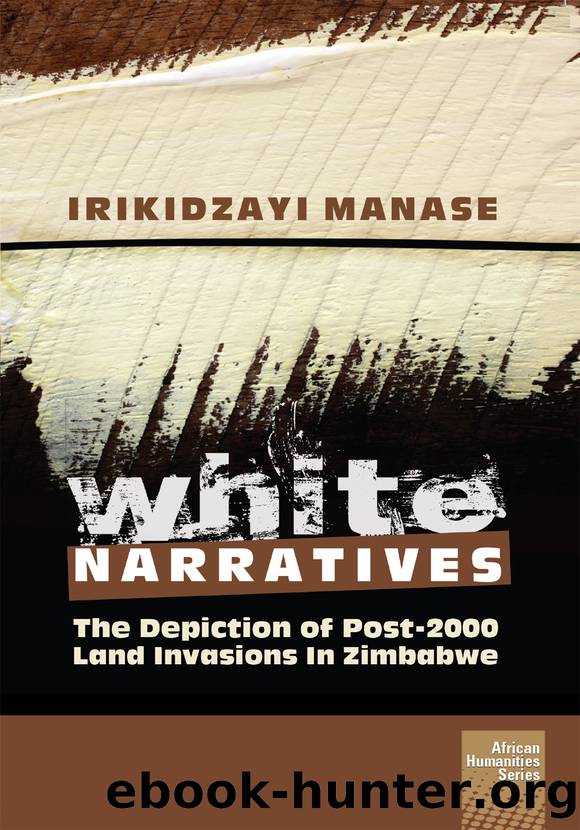
White Narratives: The Depiction of Post-2000 Land Invasions in Zimbabwe by Irikidzayi Manase
Author:Irikidzayi Manase [Manase, Irikidzayi]
Language: eng
Format: epub
Tags: African, Political Science, World
ISBN: 9781868888252
Google: rAJHEAAAQBAJ
Goodreads: 35254421
Publisher: Unisa Press
Published: 2016-07-19T00:00:00+00:00
Different âConsciousnessesâ and Multiple Perspectives on the Land
The different views about and experiences faced during the post-2000 land invasions are linked to the social class, racial and historical divisions that exist in the colonial and post-independent Zimbabwe under focus in the text. Lambâs narrative style metaphorically indicates the divided worlds that existed and how they lead to the subsequent development of different social and historical consciousness of land in both colonial and post-independent Zimbabwe. The chapters are structured in a narrative continuum that begins at âZhakataâs Krall, 1970â and ends at âKendor Farm, August 2002â. This indicates the social and spatial temporality covering the colonial period in the 1970s up to the post-colonial period and specifically the year 2002, when most commercial white farms, including Nigelâs Kendor Farm, were invaded and occupied by war veterans. The separated world, owing to racial, class and colonial geographic boundaries that characterise the represented colonial time space is illustrated from the outset in the novel. The protagonists are described as occupying different social and historical spaces as noted in the first two chapters. The experiences during the 1970s are represented as divided into African experiences at âZhakataâs kraalâ (Chapter 1) and white experiences at âRiversdale Farm, Headlands, 1971â (Chapter 2). These divisions are stylistically imprinted in the novel from the outset and metaphorically illustrate the historical and social antecedents of the multiple and opposing perspectives about land in this Zimbabwe. They also, to a larger extent confirm those binary oppositions in existence in colonial Zimbabwe, such that when the writer continues to write in such Manichean style, she fails to destabilise this relational linkage between the black and white Zimbabwean worlds, which has been historically skewed in favour of white Rhodesians and later on white Zimbabweans.
The life experiences of both Aqui and Nigel are also described as divided owing to the impact of the colonially prescribed social and historical boundaries. The colonial space, as noted by Fanon (1963), Noyes (1992) and Kalaora (2011) is a dominated one and divided into various opposing geographical and ideological boundaries. The divisions prevented the colonised subjectâs attempt to cross over to the other spaces and as a result they could not easily escape from their marginalised spaces. These geographical and ideological boundaries are represented by nodes that include Riversdale, the white commercial farms, where Nigel grows up, and cities, including Umtali and Salisbury, where Nigel goes for his primary and high school education. Furthermore, the nodes were circumscribed from the black communal rural areas and townships in colonial Rhodesia. The main protagonistsâ narratives begin with an outline of this past socio-spatial fragmentation. This therefore implies that the antecedents of the opposing perceptions of the land can best be understood by looking back to Zimbabweâs history and the associated geographical and socio-economic separations.
The effects of these colonially established social and spatial divisions are still felt during the post-independence period, as the novelâs narrative style proves. Freeman (2005:306â307) examines the opposing political and intellectual opinions focusing on the post-2000 land
Download
This site does not store any files on its server. We only index and link to content provided by other sites. Please contact the content providers to delete copyright contents if any and email us, we'll remove relevant links or contents immediately.
| Anthropology | Archaeology |
| Philosophy | Politics & Government |
| Social Sciences | Sociology |
| Women's Studies |
The Secret History by Donna Tartt(19103)
The Social Justice Warrior Handbook by Lisa De Pasquale(12197)
Thirteen Reasons Why by Jay Asher(8919)
This Is How You Lose Her by Junot Diaz(6894)
Weapons of Math Destruction by Cathy O'Neil(6284)
Zero to One by Peter Thiel(5808)
Beartown by Fredrik Backman(5767)
The Myth of the Strong Leader by Archie Brown(5513)
The Fire Next Time by James Baldwin(5454)
How Democracies Die by Steven Levitsky & Daniel Ziblatt(5225)
Promise Me, Dad by Joe Biden(5157)
Stone's Rules by Roger Stone(5091)
A Higher Loyalty: Truth, Lies, and Leadership by James Comey(4966)
100 Deadly Skills by Clint Emerson(4931)
Rise and Kill First by Ronen Bergman(4797)
Secrecy World by Jake Bernstein(4756)
The David Icke Guide to the Global Conspiracy (and how to end it) by David Icke(4723)
The Farm by Tom Rob Smith(4517)
The Doomsday Machine by Daniel Ellsberg(4493)
